Bhopal is the capital city of Madhya Pradesh.
It is also known as the City of Lakes.
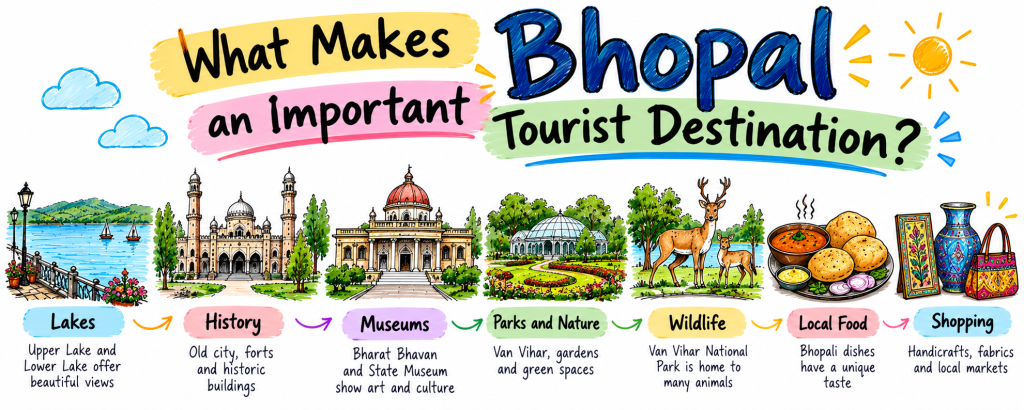
The city offers a mix of lakes, history, culture, food, museums, wildlife, and old architecture. This mix makes Bhopal different from many other Indian cities.
A visitor can enjoy a peaceful morning near Upper Lake. Later, they can explore an old palace or mosque. They can also visit a museum, wildlife park, or local market.
Bhopal also works well as a base for nearby attractions.
Sanchi and Bhimbetka are within reach of the city. Both add strong historical value to a Bhopal trip. Madhya Pradesh Tourism also includes Bhopal, Sanchi, and Bhimbetka in regional travel plans.
So, what makes Bhopal an important tourist destination?
The answer lies in its mix of nature, history, culture, food, heritage, and easy access to nearby attractions.
Why Is Bhopal Important for Tourism?
Bhopal has a rare mix of old and new.
The old city has mosques, palaces, markets, and historic buildings. The newer parts have wide roads, green spaces, museums, parks, and modern facilities.
The city’s lakes also play a major role.
Upper Lake and Lower Lake are central parts of Bhopal’s identity. The two water bodies form the Bhoj Wetland system. Upper Lake is also known as Bada Talab or Bhojtal.
Bhopal also has important museums.
The Tribal Museum and the Indira Gandhi Rashtriya Manav Sangrahalaya help visitors understand Indian culture and tribal life.
Bhopal Tourism at a Glance
| Travel Interest | What Bhopal Offers |
|---|---|
| Lakes | Upper Lake and Lower Lake |
| Heritage | Palaces, mosques, old buildings |
| Wildlife | Van Vihar National Park |
| Culture | Tribal Museum and Bharat Bhavan |
| History | Old Bhopal and nearby heritage sites |
| Food | Traditional Bhopali dishes |
| Family Travel | Sair Sapata and museums |
| Nature | Lakes, parks, hills, and green spaces |
| Education | Science and cultural museums |
| Nearby Trips | Sanchi and Bhimbetka |
This range makes Bhopal useful for different kinds of travellers.
1. The Lakes Give Bhopal Its Identity
The lakes are one of the biggest reasons people remember Bhopal.
Upper Lake is the city’s most famous water body.
Madhya Pradesh Tourism says Raja Bhoj constructed the Upper Lake in the 11th century. It covers about 36.1 square kilometres and supports boating and sightseeing.
The lake also gives the city a calm setting.
Visitors can enjoy the water, open views, and cool breeze.
The area becomes especially pleasant during early morning and evening.
Things to do near Upper Lake
Visitors can:
- Take a boat ride
- Enjoy lake views
- Watch birds
- Walk near the lake
- Visit nearby attractions
- Explore Sair Sapata
- Visit Van Vihar
- Enjoy food with a lake view
The lake is not only a tourist spot.
It is also part of daily city life.
That connection gives Bhopal a special character.
2. Upper Lake Offers Boating Experiences
Boating is one of the easiest ways to enjoy Bhopal’s lake landscape.
Madhya Pradesh Tourism lists paddle, sail, and motor boats among the boating options around Upper Lake.
The lake also has newer experiences.
MP Tourism currently highlights intimate Shikara rides, along with floating food and shopping experiences. The listed experience runs from morning until sunset, though visitors should check current timings before going.
A boat ride can suit many travellers.
Families can enjoy it together.
Couples can enjoy the views.
Photographers can capture the changing light.
Bird watchers can also look for birds around the wetland.
3. Bhopal Has a Strong Royal History
Bhopal has a long and interesting history.
The city developed through different rulers and cultural influences.
The old city still shows this history through its buildings.
Madhya Pradesh Tourism notes that the modern city was established by Dost Mohammed and later became closely linked with the Begums of Bhopal.
The Begums played an important role in the city’s development.
Their period left behind palaces, mosques, roads, water systems, and other public works.
This history gives Bhopal a distinct identity.
Visitors can still see many signs of that past.
4. The Begums of Bhopal Left a Strong Heritage
Bhopal has an unusual royal history.
Several women ruled the princely state during the 19th and early 20th centuries.
Their influence can still be seen in the city’s heritage.
Places such as:
- Gauhar Mahal
- Sadar Manzil
- Shaukat Mahal
- Moti Masjid
- Taj-ul-Masajid
help visitors understand the city’s royal and cultural past.
These places also show different styles of architecture.
Some buildings mix Indian and Islamic design.
Others reflect the city’s royal traditions.
A heritage walk through old Bhopal can therefore feel like a journey through different periods.
5. Gauhar Mahal Shows Bhopal’s Royal Architecture
Gauhar Mahal is one of Bhopal’s important heritage buildings.
Qudsia Begum built it between 1819 and 1837.
Madhya Pradesh Tourism describes it as a blend of Hindu and Mughal architectural traditions.
The palace has courtyards, pathways, stairs, and views toward Upper Lake.
It also hosts craft-related activities.
Visitors can explore traditional handicrafts in the area.
This makes Gauhar Mahal useful for both heritage and cultural tourism.
It is not simply an old building.
It also connects architecture with local crafts.
6. Taj-ul-Masajid Adds Religious and Architectural Value
Taj-ul-Masajid is one of Bhopal’s most famous landmarks.
Its name means “Crown Among Mosques.”
The large mosque dominates the skyline of the old city.
Its scale and architecture attract visitors interested in history and Islamic architecture. Madhya Pradesh Tourism lists Taj-ul-Masajid among Bhopal’s major attractions.
Visitors should remember that it is also a place of worship.
So, respectful behaviour matters.
Dress should be suitable.
Visitors should follow local entry rules.
Photography rules should also be checked before taking pictures.
7. Old Bhopal Gives a Different Travel Experience
Old Bhopal feels different from the newer parts of the city.
The area has narrow streets, old buildings, markets, mosques, food shops, and traditional businesses.
Madhya Pradesh Tourism recommends exploring areas around Chowk and other old-city heritage locations.
This part of the city is useful for travellers who want to understand local life.
You can explore the streets slowly.
You can look at old architecture.
You can try local food.
You can also shop for traditional items.
The experience is more about observing the city than rushing between landmarks.
8. Bhopal Has Important Museums
Bhopal is also a strong museum city.
The museums cover science, tribal culture, anthropology, art, and Indian traditions.
Important examples include:
- Madhya Pradesh Tribal Museum
- Indira Gandhi Rashtriya Manav Sangrahalaya
- Regional Science Centre
- Bharat Bhavan
- Birla Museum
Madhya Pradesh Tourism lists these among the city’s important cultural and educational attractions.
This makes Bhopal useful for students and families.
Museums can also help visitors understand the state before exploring rural areas.
9. The Tribal Museum Shows Living Culture
The Madhya Pradesh Tribal Museum is one of Bhopal’s most distinctive museums.
It focuses on tribal communities and their traditions.
The museum uses large displays, models, art, objects, and recreated spaces.
Madhya Pradesh Tourism says the museum presents tribal heritage through full-scale models and colourful installations.
The experience feels different from a museum with only glass cases.
Visitors can see how homes, traditions, tools, art, and beliefs connect.
This makes the museum useful for anyone interested in Indian culture.
It is also a good stop for families and students.
10. Indira Gandhi Rashtriya Manav Sangrahalaya Offers Another View of India
The Indira Gandhi Rashtriya Manav Sangrahalaya is also called the Museum of Man.
It spreads across a large open area near Upper Lake.
Madhya Pradesh Tourism describes it as a major anthropological museum with open-air displays of human settlements.
Visitors can see traditional dwelling styles.
The displays represent different regions and communities.
This gives people a simple way to understand India’s cultural diversity.
The museum is especially useful for visitors who enjoy history and anthropology.
11. Regional Science Centre Makes Learning Fun
Bhopal also has something for science lovers.
The Regional Science Centre is located around Shyamla Hills.
Madhya Pradesh Tourism says it has more than 300 interactive exhibits. It also hosts sky observation events on some weekends.
Interactive exhibits can make science easier to understand.
This makes the centre useful for children.
It can also be useful for school groups.
A family can combine the science centre with nearby lake and museum visits.
12. Van Vihar Brings Wildlife Into the City
Van Vihar National Park is another major reason to visit Bhopal.
The park sits beside Upper Lake.
Madhya Pradesh Tourism describes Van Vihar as a 445-hectare zoological park with animals such as tigers, lions, bears, hyenas, deer, sambhar, and blackbuck. It also records a wide variety of bird species.
Its location makes it special.
You do not need to travel deep into a forest to see wildlife.
The lake adds a natural setting around the park.
Visitors can also enjoy walking and cycling experiences.
Morning visits can be pleasant, but visitors should always check current park timings before going.
13. Bhopal Is Good for Bird Watching
The city’s wetlands support bird life.
Upper Lake and Lower Lake form part of the Bhoj Wetland system.
Madhya Pradesh Tourism highlights Bhopal as a birdwatching destination and notes that Bhoj Wetland is a Ramsar site.
Bird lovers can look for different species around the wetland.
The best experience depends on the season and location.
Early morning often gives better conditions for bird watching.
A pair of binoculars can help.
Visitors should keep noise low near birds.
14. Bhopal Has Green Spaces and Natural Views
Bhopal is not only a busy capital city.
It also has many green areas.
The lakes, hills, parks, and forests give the city a natural setting.
The Upper Lake area is especially important.
Madhya Pradesh Tourism calls Upper Lake the “soul of Bhopal” and highlights its role in the city’s landscape.
This natural side makes Bhopal suitable for slow travel.
Visitors can spend part of the day outdoors.
They do not need to visit a major attraction every hour.
15. Sair Sapata Is Useful for Family Travel
Sair Sapata is an entertainment complex near Upper Lake.
It offers family-oriented activities and lake views.
Madhya Pradesh Tourism lists it as an open-air entertainment area on the Upper Lake side.
It can be useful when travelling with children.
Families can combine:
Upper Lake + Sair Sapata + Van Vihar
into one broad sightseeing plan.
This reduces unnecessary travel around the city.
16. Bhopal Has a Strong Food Culture
Food is another important part of Bhopal tourism.
The city’s cuisine reflects its history and cultural mix.
Visitors can find both vegetarian and non-vegetarian dishes.
Popular Bhopali food experiences include:
- Poha
- Jalebi
- Bhopali gosht
- Korma
- Seekh kebab
- Local snacks
- Paan
Madhya Pradesh Tourism highlights Bhopal’s food culture and notes the influence of Islamic culinary traditions.
Food becomes more interesting when you explore local markets.
Try smaller local places when they have good hygiene and strong local reputation.
17. Bhopal’s Markets Add Local Colour
Markets are useful for understanding a city.
Bhopal’s older market areas offer traditional products, food, clothing, crafts, and daily goods.
Chowk is one of the historic market areas.
Visitors can walk through the market and see how old and new businesses work together.
You may also find traditional crafts.
Zari and zardozi work have a place in Bhopal’s craft culture.
If you buy crafts, ask about the material and how the product was made.
This can make shopping more meaningful.
18. Bharat Bhavan Adds Art and Culture
Bharat Bhavan is another important cultural space in Bhopal.
It is a multi-arts centre.
Madhya Pradesh Tourism includes Bharat Bhavan in its Bhopal itineraries.
The centre connects different forms of Indian art.
Visitors interested in literature, theatre, visual art, and cultural programs may find it useful.
It also adds a modern cultural side to Bhopal.
This matters because the city is not only about old monuments.
It also supports contemporary cultural activity.
19. Bhopal Is Close to Important Heritage Sites
One major advantage of Bhopal is its location.
The city can work as a base for nearby historical destinations.
Two important examples are:
- Sanchi
- Bhimbetka
Madhya Pradesh Tourism lists Sanchi as about 48 km from Bhopal and highlights Bhimbetka as a UNESCO World Heritage Site.
This means visitors can create a wider central Madhya Pradesh trip.
They can stay in Bhopal.
Then they can take day trips to nearby heritage locations.
20. Sanchi Adds Buddhist Heritage
Sanchi is an important Buddhist heritage site.
It has stupas, temples, monasteries, pillars, and other monuments.
The site is a UNESCO World Heritage Site.
Its monuments represent important stages in the history of Buddhism in India.
For travellers interested in Buddhism and Indian history, Sanchi offers a strong learning experience.
It can also be combined with Bhopal without needing a long multi-day journey.
21. Bhimbetka Connects Bhopal With Prehistoric History
Bhimbetka offers another kind of historical experience.
The rock shelters contain prehistoric paintings.
The site is also a UNESCO World Heritage Site.
Madhya Pradesh Tourism lists Bhimbetka among the state’s major heritage attractions.
This makes the area valuable for students, history lovers, families, and researchers.
It also shows how different Bhopal’s nearby attractions can be.
One trip can include:
Royal history + Buddhist history + prehistoric art
That is a strong combination.
22. Bhopal Has Good Travel Connections
Bhopal is also practical for travellers.
Madhya Pradesh Tourism states that Raja Bhoj Airport is about 13 km northwest of the city centre. It also notes rail links and road connections with several major destinations.
This makes Bhopal a useful starting point.
Common ways to reach Bhopal
| Mode | Useful For |
|---|---|
| Flight | Travellers from major cities |
| Train | Long-distance and regional travel |
| Bus | Nearby cities and road trips |
| Taxi | Local and nearby sightseeing |
| Auto-rickshaw | Short city trips |
| Local transport | City sightseeing |
Before travelling, check current schedules.
Transport times and routes can change.
23. Bhopal Works for Short Trips
You do not need a week to see the main city.
A short trip can cover several important places.
Example 2-Day Bhopal Plan
| Day | Morning | Afternoon | Evening |
|---|---|---|---|
| Day 1 | Upper Lake | Tribal Museum | Old Bhopal |
| Day 2 | Van Vihar | Gauhar Mahal | Lake area |
This plan gives a mix of nature, culture, history, and local life.
You can change the order based on opening hours.
24. Example 3-Day Bhopal and Nearby Trip
If you have more time, add a nearby heritage destination.
| Day | Destination | Main Experience |
|---|---|---|
| Day 1 | Bhopal | Lakes and museums |
| Day 2 | Bhopal | Heritage and wildlife |
| Day 3 | Sanchi or Bhimbetka | Heritage and history |
This gives the trip more depth.
You also avoid trying to visit too many places in one day.
25. Bhopal Is Suitable for Different Types of Travellers
The city does not target only one type of visitor.
For families
Families can explore:
- Upper Lake
- Sair Sapata
- Regional Science Centre
- Tribal Museum
- Van Vihar
For history lovers
They can explore:
- Gauhar Mahal
- Sadar Manzil
- Shaukat Mahal
- Taj-ul-Masajid
- Old Bhopal
- Sanchi
- Bhimbetka
For nature lovers
They can choose:
- Upper Lake
- Bhoj Wetland
- Van Vihar
- Nearby green areas
For culture lovers
They can explore:
- Tribal Museum
- Bharat Bhavan
- Local markets
- Gauhar Mahal
- Cultural events
26. A Simple Bhopal Travel Decision Table
| If You Like | Start With |
|---|---|
| Lakes | Upper Lake |
| Wildlife | Van Vihar |
| Royal history | Gauhar Mahal |
| Islamic architecture | Taj-ul-Masajid |
| Tribal culture | Tribal Museum |
| Science | Regional Science Centre |
| Local markets | Old Bhopal |
| Buddhist history | Sanchi |
| Prehistoric history | Bhimbetka |
| Family activities | Sair Sapata |
This makes trip planning easier.
You can choose places based on your interests instead of following a long list.
27. When Is the Best Time to Visit Bhopal?
The best time depends on what you want to do.
For outdoor sightseeing, cooler months are usually more comfortable.
Winter can be useful for:
- Lake visits
- Walking
- Wildlife
- Heritage sightseeing
- Day trips
The monsoon can also make the city greener.
However, heavy rain can affect outdoor plans.
Summer can feel hot, especially during the middle of the day.
So, plan outdoor activities carefully.
Always check the current weather before travelling.
28. How to Plan a Better Bhopal Trip
Start with your main interest.
Do not try to visit every attraction.
Instead, group nearby places.
For example:
Upper Lake + Van Vihar + Sair Sapata
can make one natural and family-focused route.
Another day can focus on:
Gauhar Mahal + Old Bhopal + Taj-ul-Masajid
This approach saves time.
It also makes the trip less tiring.
29. Common Mistakes Tourists Should Avoid
Mistake 1: Trying to see everything
Bhopal has many attractions.
Do not turn the trip into a race.
Mistake 2: Ignoring travel time
Nearby places may still require road travel.
Check the route before planning.
Mistake 3: Visiting monuments without checking rules
Some places have entry restrictions.
Check current timings before visiting.
Mistake 4: Ignoring local customs
Mosques, temples, and cultural sites deserve respectful behaviour.
Mistake 5: Planning all outdoor activities at noon
Early morning and evening can be more comfortable.
Mistake 6: Forgetting nearby destinations
Sanchi and Bhimbetka can add strong historical value to a Bhopal trip.
30. Responsible Tourism in Bhopal
Good tourism should protect the places people visit.
This matters around lakes, wildlife areas, museums, and heritage buildings.
Visitors should:
- Avoid littering
- Follow park rules
- Keep noise low near wildlife
- Respect religious places
- Avoid damaging old structures
- Support local businesses
- Avoid disturbing local communities
- Use water carefully
Madhya Pradesh Tourism also promotes responsible tourism around Bhopal and nearby villages.
Small actions can help protect the city’s tourism value.
31. Why Bhopal Is More Than a City of Lakes
The title “City of Lakes” is useful.
But it does not explain the whole city.
Bhopal also has:
Royal history
Islamic architecture
Tribal culture
Museums
Wildlife
Food
Markets
Art
Science
Nearby UNESCO sites
That is why Bhopal can support several types of travel.
The lakes may attract you first.
The history and culture can make you stay longer.
32. What Makes Bhopal Different From Other Tourist Cities?
Many Indian cities have monuments.
Many have museums.
Many have food markets.
But Bhopal brings several of these experiences close together.
You can start your day beside a large lake.
Then visit a wildlife park.
After that, you can explore a tribal museum.
Later, you can walk through an old market.
You can finish the day with local food.
This variety makes Bhopal easy to explore.
It also makes the city useful for short breaks.
33. A Practical Bhopal Travel Checklist
Before travelling, check:
- Hotel location
- Transport booking
- Attraction timings
- Museum timings
- Wildlife park rules
- Religious site rules
- Weather
- Local transport
- Nearby day trips
- Food options
- Emergency contacts
Madhya Pradesh Tourism also provides official tourist information, approved guides, maps, itineraries, and destination resources.
Using official information before travel can reduce avoidable problems.
34. A Simple Bhopal Travel Strategy
If you are visiting Bhopal for the first time, use this simple plan.
Step 1: Start with Upper Lake
This gives you a quick feel for the city.
Step 2: Add one museum
Choose the Tribal Museum or Manav Sangrahalaya.
Step 3: Explore heritage
Visit Gauhar Mahal or the old city.
Step 4: Add wildlife
Visit Van Vihar if you enjoy nature.
Step 5: Try local food
Explore a trusted local food area.
Step 6: Add one nearby destination
Choose Sanchi or Bhimbetka if you have extra time.
This approach gives you a balanced trip.
Final Thoughts
Bhopal is important as a tourist destination because it offers much more than one famous attraction.
The city combines lakes, history, culture, wildlife, museums, food, architecture, and nearby heritage sites.
Upper Lake gives Bhopal its famous natural setting.
Gauhar Mahal and other old buildings show its royal past.
Taj-ul-Masajid adds architectural and religious importance.
The Tribal Museum and Manav Sangrahalaya show India’s cultural diversity.
Van Vihar brings wildlife close to the city.
Sanchi and Bhimbetka add major heritage experiences nearby.
This variety makes Bhopal suitable for many travellers.
Families can find educational and fun activities.
History lovers can explore old monuments.
Nature lovers can enjoy lakes and wildlife.
Culture lovers can visit museums and markets.
Travellers with more time can use Bhopal as a base for nearby destinations.
The best way to explore Bhopal is not to rush.
Choose a few places that match your interests.
Group nearby attractions together.
Check current timings before visiting.
Respect local culture and heritage.
Also leave some time to simply enjoy the city.
That is often when Bhopal feels most memorable.
Frequently Asked Questions
What makes Bhopal an important tourist destination?
Bhopal combines lakes, heritage, museums, wildlife, culture, food, and nearby historical destinations. This variety gives travellers many experiences in one city.
Why is Bhopal called the City of Lakes?
Bhopal is known for its major lakes, especially Upper Lake and Lower Lake. The lakes form an important part of the city’s landscape and identity.
What is Bhopal famous for?
Bhopal is known for Upper Lake, Van Vihar, Taj-ul-Masajid, Gauhar Mahal, museums, old-city heritage, and local food.
What are the best places to visit in Bhopal?
Popular attractions include Upper Lake, Van Vihar National Park, Gauhar Mahal, Taj-ul-Masajid, Tribal Museum, Manav Sangrahalaya, Sair Sapata, and Regional Science Centre.
Is Bhopal good for family travel?
Yes. Families can combine museums, lakes, wildlife, science exhibits, and entertainment areas.
Is Bhopal good for history lovers?
Yes. The city has royal buildings, mosques, old markets, and heritage sites. Sanchi and Bhimbetka also offer important historical experiences nearby.
Is Bhopal good for wildlife lovers?
Yes. Van Vihar National Park offers wildlife and birdwatching close to Upper Lake.
What can tourists do at Upper Lake?
Visitors can enjoy boating, sightseeing, bird watching, walking, and lake views. Current boating options and timings should be checked before visiting.
Is Sanchi close to Bhopal?
Yes. Madhya Pradesh Tourism places Sanchi at about 48 km from Bhopal.
Is Bhimbetka close to Bhopal?
Bhimbetka is within the wider Bhopal region and works well as a nearby heritage trip. It is also a UNESCO World Heritage Site.
What food is Bhopal known for?
Bhopal offers both vegetarian and non-vegetarian dishes. Local food includes poha, jalebi, kebabs, korma, and other traditional dishes.
How many days are enough for Bhopal?
Two days can cover many major city attractions. Three days can allow more relaxed sightseeing or a nearby trip.
How should first-time visitors plan Bhopal?
Start with Upper Lake, then add a museum, heritage site, wildlife experience, and local food. If you have extra time, add Sanchi or Bhimbetka.
#BhopalTourism #BhopalTravel #VisitBhopal #CityOfLakes #BhopalTouristPlaces #MadhyaPradeshTourism #ExploreBhopal #BhopalTrip
