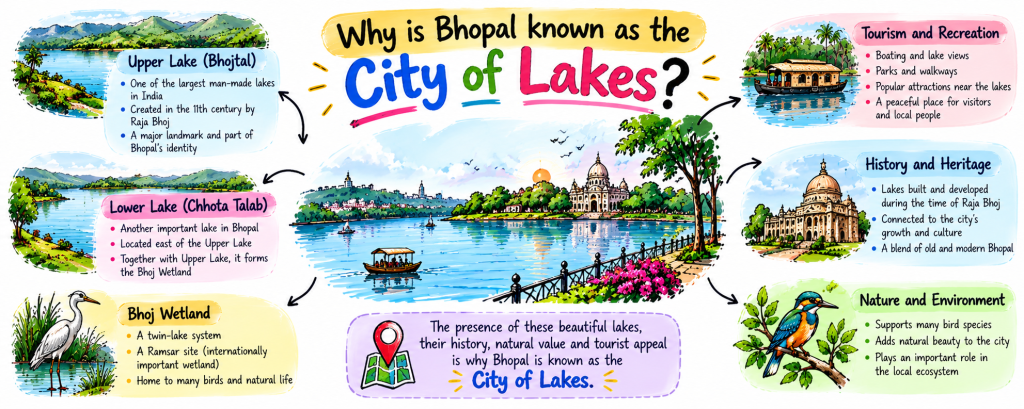
Bhopal is the capital of Madhya Pradesh.
It is also widely known as the City of Lakes.
The name comes from the lakes that shape the city.
The Upper Lake and Lower Lake are the most important water bodies in Bhopal.
They are not just scenic places.
They have also played an important role in the city’s history and daily life.
The district government describes Bhopal as a city surrounded by lakes and hills. It also says the two lakes form the core of the city.
So, why did Bhopal become known as the City of Lakes?
The answer starts with the history of its lakes.
The Upper Lake Gives Bhopal Its Famous Identity
The Upper Lake is also called Bhojtal or Bada Talab.
It is the most famous lake in Bhopal.
Madhya Pradesh Tourism says the lake was created in the 11th century by Raja Bhoj. An earthen dam was built across the Kolans River to create the reservoir.
This makes the lake much more than a tourist attraction.
It is part of the city’s long history.
The lake has also remained closely connected with Bhopal’s growth.
Today, people visit the Upper Lake for its open views and calm setting.
Visitors can also enjoy boating and other lake-based activities.
The lake is surrounded by parts of the modern city.
This creates a mix of water, hills, roads, parks, and buildings.
That mix is one reason the lake has become a strong symbol of Bhopal.
The Lower Lake Completes the Twin-Lake Landscape
Bhopal’s second major lake is the Lower Lake.
It is also known as Chhota Talab.
The Lower Lake lies east of the Upper Lake.
Together, the two lakes form the Bhoj Wetland.
The Ramsar information sheet identifies Bhoj Wetland as a twin-lake system made up of the Upper and Lower lakes. It records the Upper Lake as an 11th-century man-made reservoir and the Lower Lake as a later water body built downstream.
This twin-lake system is central to Bhopal’s identity.
It also shows why the city’s nickname is closely linked with water.
Why Are the Lakes Important to Bhopal?
The lakes are important for more than their beauty.
They are part of the city’s natural and urban landscape.
The Bhopal district website says the two lakes still dominate the city and form its nucleus.
The lakes also support birds and other wetland life.
Bhoj Wetland is a Ramsar site.
That means it has international recognition as an important wetland.
The wetland provides habitat for many waterbirds.
It also adds ecological value to a city that has grown around these water bodies.
So, the lakes connect history, nature, tourism, and city life.
Bhopal’s Lakes Are Part of Its Tourism
The lakes are among Bhopal’s major tourist attractions.
Visitors can spend time near the Upper Lake.
They can enjoy views across the water.
Boating is also available at the Upper Lake.
Madhya Pradesh Tourism lists paddle, sail, and motor boat experiences at the lake.
The lakes also connect with several nearby attractions.
Van Vihar National Park lies beside the Upper Lake.
Sair Sapata is another attraction located along the lake.
Visitors can also explore museums, parks, and cultural places nearby.
This makes the lake area useful for a full day of sightseeing.
The Lakes Connect Bhopal’s Old and New Sides
Bhopal has a mix of old and modern areas.
The old city has historic mosques, markets, palaces, and narrow streets.
The newer parts have wider roads, shopping areas, hotels, and modern buildings.
The Upper Lake sits between these different parts of the city.
Madhya Pradesh Tourism describes Bhopal as two contrasting cityscapes connected around the lakes.
This gives visitors a clear view of the city’s changing character.
You can explore old Bhopal in the morning.
Later, you can enjoy the lake and modern city areas.
The contrast makes the trip more interesting.
The Lakes Have a Long Historical Story
The story of Bhopal’s lakes goes back many centuries.
The Upper Lake is linked with Raja Bhoj.
According to the official tourism and Ramsar information, the reservoir was created in the 11th century.
Over time, the water body became an important part of Bhopal.
The city’s development continued around it.
The Lower Lake was added much later.
Together, these water bodies became a major part of the city’s landscape.
This long history helps explain why the lakes are more than just scenic spots.
They are part of Bhopal’s story.
The Lakes Also Support Bird Watching
Bhopal’s lakes are useful for people who enjoy nature.
Wetlands can provide important places for birds to feed and rest.
The Bhoj Wetland supports many bird species.
Madhya Pradesh Tourism describes Bhoj Wetland as a bird-rich area and highlights bird watching around Bhopal’s water bodies.
Bird watching can be a simple activity.
You do not need a complicated plan.
A quiet visit near the lake can give you a chance to observe birds.
Winter can also bring migratory birds to the area.
Visitors should avoid loud sounds and should not disturb birds.
The Lakes Add Natural Beauty to the City
Bhopal is surrounded by lakes and hills.
This gives the city a different look from many large urban areas.
The district government specifically notes the city’s lakes, hills, and natural beauty.
The Upper Lake is especially noticeable from different parts of the city.
The water creates open views in an otherwise busy urban setting.
Sunrise and sunset can also make the lake area attractive for visitors.
The surrounding parks add more green space.
This combination helps explain the strong connection between Bhopal and its lakes.
The Lakes Are Part of Everyday City Life
The lakes are not only for tourists.
They are part of the city’s everyday landscape.
People visit the lake area for walks, recreation, boating, and relaxation.
The water bodies also have environmental importance.
This means protecting them matters for both residents and visitors.
Tourists can help by keeping the area clean.
Avoid throwing plastic or other waste near the water.
Do not disturb birds or other wildlife.
Small actions can help protect the lake environment.
What Can Visitors Do Around Upper Lake?
The Upper Lake area offers several simple activities.
You can begin with a walk near the waterfront.
Then you can explore nearby attractions.
You can also choose a boating experience.
Van Vihar National Park is close to the lake.
Sair Sapata is another nearby attraction.
Madhya Pradesh Tourism also highlights lake-view experiences and attractions around the Upper Lake.
This makes the lake a useful starting point for Bhopal sightseeing.
You do not need to spend the whole day at one place.
You can combine the lake with nearby attractions.
Best Time to Enjoy the Lake Area
The best time depends on what you want to do.
Early morning can be peaceful.
Evening can be useful for lake views and a relaxed walk.
Winter can be interesting for bird watchers.
Weather can affect outdoor activities.
So, check local conditions before planning a long outdoor visit.
Also check current timings for boating and nearby attractions.
Rules and services can change.
Other Places to See in Bhopal
The lakes are important, but Bhopal has more to offer.
The district tourism website lists several attractions.
These include:
- Van Vihar National Park
- Bharat Bhavan
- Birla Temple
- Taj-ul-Masajid
- Jama Masjid
- Gohar Mahal
- Shaukat Mahal
- Regional Science Centre
- Indira Gandhi Rashtriya Manav Sangrahalaya
- Kerwa Dam
The city therefore offers a mix of nature, history, culture, and architecture.
Visitors can easily combine lake sightseeing with these places.
Why Is the Name “City of Lakes” Still Relevant?
The nickname is not only a tourism slogan.
The lakes remain a visible part of Bhopal.
The Upper and Lower lakes shape the city’s landscape.
They also support recreation, tourism, and wetland life.
The district government continues to describe Bhopal as the City of Lakes.
Madhya Pradesh Tourism also uses the same identity for the city.
So, the name has a clear connection with the city’s geography and history.
A Simple Way to Explore Bhopal’s Lakes
If you have limited time, keep your plan simple.
Start with the Upper Lake.
Spend some time near the water.
If boating is available, check the current options.
Then visit a nearby attraction such as Van Vihar.
You can later explore Bhopal’s historic areas.
This plan gives you a mix of nature, recreation, and culture.
You also avoid spending too much time travelling between distant places.
What Should Visitors Remember?
The lakes are beautiful, but they are also important wetlands.
Visitors should treat them with care.
Do not leave waste near the water.
Avoid feeding birds unless local authorities specifically allow it.
Follow boating rules.
Respect restricted areas.
Keep noise low near wildlife.
These simple habits help protect the places that make Bhopal special.
Final Thoughts
Bhopal is called the City of Lakes because its lakes are deeply connected with the city’s identity.
The Upper Lake and Lower Lake form the core of the Bhoj Wetland.
The Upper Lake has a history going back to the 11th century.
The Lower Lake was developed later.
Together, they have shaped Bhopal’s landscape and tourism.
The lakes also support wetland life and bird habitats.
For visitors, they offer boating, open views, nature, and easy access to other attractions.
But their value goes beyond tourism.
They are part of Bhopal’s history and urban life.
That is why the name City of Lakes continues to describe Bhopal so well.
Quick Takeaway
Bhopal is known as the City of Lakes mainly because of its historic Upper and Lower lakes.
The lakes form the Bhoj Wetland.
They are important for tourism, nature, recreation, and the city’s identity.
When you visit Bhopal, spending time around the lakes can help you understand the city better.
Hashtags
#Bhopal · #BhopalTourism · #CityOfLakes · #BhopalTravel · #MadhyaPradeshTourism · #BhojWetland · #VisitBhopal
