Introduction
Modern IT environments have become increasingly complex. Organizations now manage applications across on-premises data centers, public clouds, hybrid infrastructures, containers, microservices, and distributed systems. As digital transformation accelerates, IT operations teams face growing challenges in monitoring systems, managing incidents, maintaining uptime, and ensuring optimal performance.
Traditional IT operations tools often struggle to keep pace with the enormous volume of data generated by modern infrastructure. Millions of events, logs, alerts, and performance metrics can overwhelm operations teams, making it difficult to identify critical issues before they impact users.
This is where AIOps comes into play.
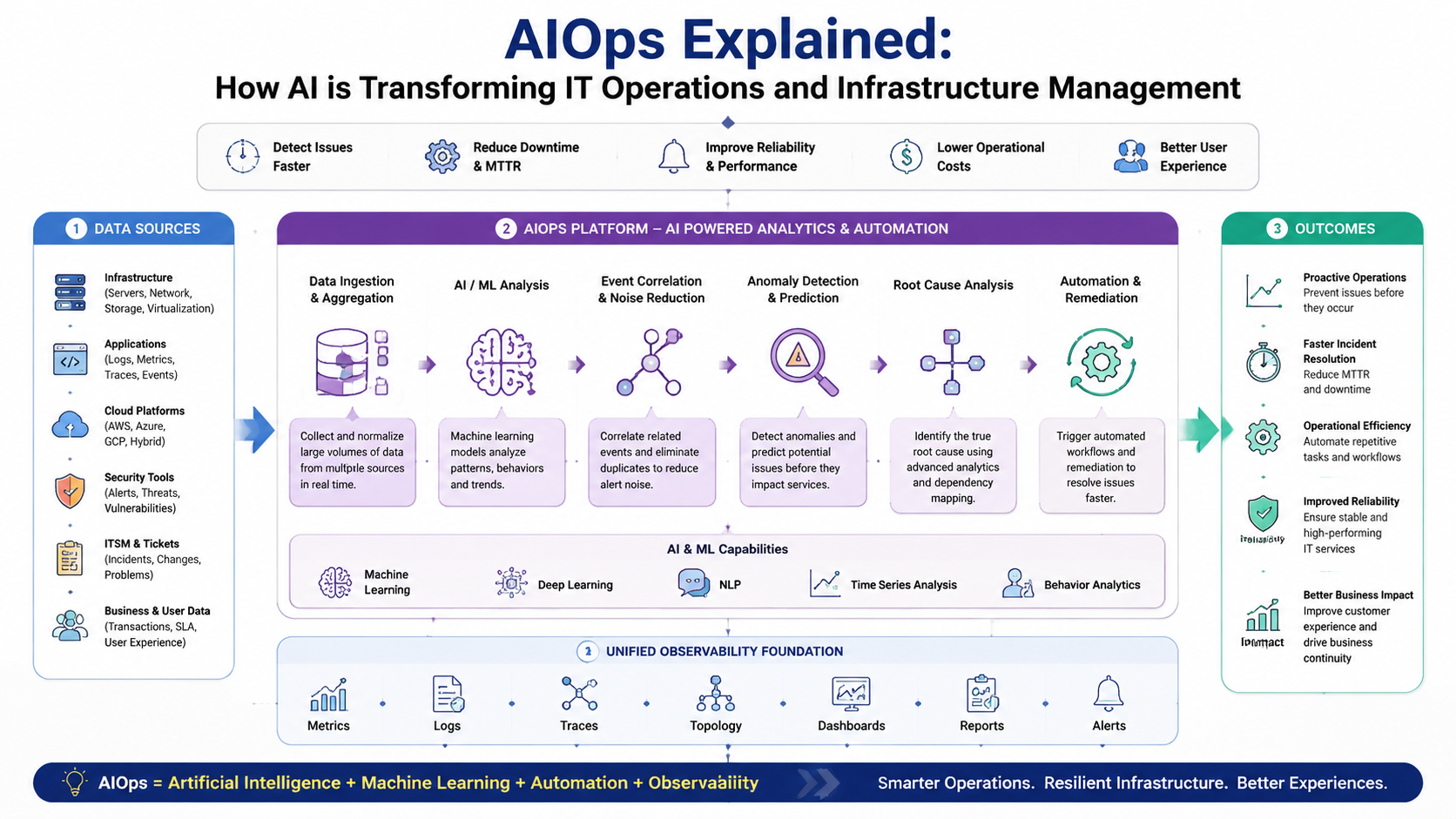
AIOps, or Artificial Intelligence for IT Operations, combines artificial intelligence, machine learning, big data analytics, and automation to improve IT operations management. By analyzing vast amounts of operational data in real time, AIOps helps organizations detect anomalies, predict issues, identify root causes, automate responses, and optimize infrastructure performance.
In this guide, we will explore what AIOps is, how it works, its key benefits, major use cases, essential tools, and why it is becoming a critical capability for modern IT organizations.
What Is AIOps?
AIOps stands for Artificial Intelligence for IT Operations. The term refers to the application of artificial intelligence and machine learning technologies to automate and enhance IT operations processes.
Instead of relying solely on manual monitoring and reactive troubleshooting, AIOps platforms continuously analyze operational data to identify patterns, detect anomalies, and provide actionable insights.
The primary goal of AIOps is to help organizations:
- Reduce operational complexity
- Improve service reliability
- Accelerate incident resolution
- Minimize downtime
- Enhance customer experience
- Automate repetitive operational tasks
AIOps transforms IT operations from reactive management to proactive and predictive management.
Why Traditional IT Operations Are No Longer Enough
Traditional monitoring approaches were designed for relatively simple infrastructures. Today’s environments are far more dynamic and distributed.
Challenges faced by modern IT teams include:
Alert Fatigue
Operations teams receive thousands of alerts daily. Many alerts are duplicates, false positives, or symptoms rather than root causes.
Massive Data Volumes
Applications generate huge amounts of logs, metrics, traces, and events that are difficult for humans to analyze manually.
Complex Dependencies
Modern systems contain interconnected services, APIs, containers, cloud platforms, and microservices, making troubleshooting more complicated.
Faster Business Expectations
Organizations expect near-zero downtime and rapid issue resolution.
Resource Constraints
IT teams are expected to manage increasingly complex environments without proportional increases in staffing.
AIOps helps address these challenges through intelligent automation and data-driven decision-making.
How AIOps Works
AIOps platforms typically follow a structured process to transform operational data into actionable intelligence.
Data Collection
The platform gathers data from multiple sources, including:
- Infrastructure monitoring tools
- Application monitoring systems
- Log management platforms
- Cloud services
- Network devices
- Security systems
- Service desks
- Configuration management databases
Data Aggregation
Collected data is centralized into a unified platform where information from different sources can be correlated.
Machine Learning Analysis
Machine learning algorithms analyze data patterns to:
- Identify anomalies
- Detect unusual behavior
- Predict failures
- Recognize recurring incidents
Event Correlation
AIOps platforms reduce noise by grouping related events and identifying the underlying issue causing multiple alerts.
Root Cause Analysis
The system automatically identifies likely causes of incidents, helping teams resolve problems faster.
Automated Response
Many AIOps platforms can trigger automated remediation workflows to resolve common issues without human intervention.
Core Components of AIOps
Big Data Platform
AIOps relies on collecting and processing large volumes of operational data from various sources.
Machine Learning
Machine learning models identify patterns, anomalies, and trends that may indicate operational issues.
Analytics Engine
Advanced analytics help extract meaningful insights from complex operational datasets.
Automation Framework
Automation enables repetitive tasks and incident responses to be executed automatically.
Visualization and Reporting
Dashboards provide real-time visibility into system performance and operational health.
Key Benefits of AIOps
Faster Incident Detection
AIOps continuously monitors systems and identifies abnormalities before they become major outages.
Reduced Downtime
Predictive capabilities help organizations prevent failures and maintain service availability.
Improved Root Cause Analysis
Instead of investigating hundreds of alerts manually, teams can quickly identify the actual source of a problem.
Better Operational Efficiency
Automation reduces repetitive manual work and allows engineers to focus on strategic initiatives.
Enhanced User Experience
Reliable systems and faster issue resolution improve customer satisfaction.
Lower Operational Costs
Organizations can reduce costs associated with outages, troubleshooting efforts, and resource inefficiencies.
Improved Scalability
AIOps supports growing infrastructure without requiring equivalent increases in operational staff.
Real-World AIOps Use Cases
Intelligent Incident Management
AIOps automatically identifies, prioritizes, and routes incidents to appropriate teams.
Predictive Maintenance
Machine learning predicts infrastructure failures before they occur.
Root Cause Analysis
Correlates logs, metrics, and events to identify the underlying cause of incidents.
Capacity Planning
Analyzes historical usage trends to predict future resource requirements.
Performance Optimization
Continuously monitors applications and infrastructure to improve performance.
Cloud Operations
Provides visibility and optimization across complex cloud environments.
Security Operations Support
Detects unusual behavior and assists security teams in identifying potential threats.
Network Monitoring
Identifies network anomalies and performance degradation in real time.
AIOps and Observability
Observability and AIOps are closely related.
Observability focuses on understanding system behavior through:
- Metrics
- Logs
- Traces
AIOps enhances observability by applying machine learning and analytics to observational data.
Together they help organizations:
- Detect issues faster
- Improve troubleshooting
- Understand system dependencies
- Enhance service reliability
AIOps for Site Reliability Engineering
Site Reliability Engineering teams increasingly use AIOps to improve service reliability.
Benefits include:
- Faster incident response
- Reduced Mean Time To Detect
- Reduced Mean Time To Resolve
- Automated remediation
- Improved service-level objective management
AIOps helps SRE teams focus on reliability engineering rather than repetitive operational tasks.
AIOps and Cloud Infrastructure Management
Cloud environments introduce additional operational complexity.
Organizations often use multiple cloud providers alongside on-premises infrastructure.
AIOps supports cloud operations through:
- Cloud performance monitoring
- Resource optimization
- Cost management insights
- Capacity forecasting
- Automated scaling recommendations
- Multi-cloud visibility
This enables organizations to manage cloud environments more efficiently.
Popular AIOps Tools
Several leading platforms support AIOps initiatives.
Splunk ITSI
Provides advanced analytics, event correlation, and operational intelligence.
Dynatrace
Offers AI-powered observability and automatic root cause analysis.
Datadog
Combines monitoring, observability, and intelligent analytics.
New Relic
Provides end-to-end visibility and operational insights.
IBM Cloud Pak for AIOps
Focuses on incident management, automation, and operational resilience.
Moogsoft
Specializes in event correlation and noise reduction.
PagerDuty AIOps
Enhances incident response and operational workflows.
BigPanda
Provides event intelligence and operational automation.
LogicMonitor
Delivers infrastructure monitoring with AI-driven insights.
AppDynamics
Offers application performance monitoring and business observability.
AIOps Implementation Best Practices
Define Clear Objectives
Identify specific operational challenges and measurable outcomes.
Start with High-Value Use Cases
Focus initially on incident management, alert reduction, or root cause analysis.
Ensure Data Quality
Machine learning effectiveness depends on accurate and complete data.
Integrate Existing Tools
Leverage existing monitoring, logging, and service management investments.
Build Automation Gradually
Start with low-risk automation before expanding to critical workflows.
Continuously Improve Models
Machine learning models should evolve as environments and workloads change.
Train Teams
Operations teams must understand both AIOps technology and operational processes.
Challenges of AIOps Adoption
Despite its benefits, organizations may encounter challenges.
Data Silos
Operational data may be scattered across multiple platforms.
Integration Complexity
Connecting legacy and modern systems can require significant effort.
Skills Gap
Teams may need training in AI, machine learning, and automation concepts.
Change Management
Operational processes often require adjustment to support automation.
Initial Investment
Implementing AIOps platforms may require upfront investments in technology and training.
Organizations that address these challenges effectively often realize significant long-term benefits.
The Future of AIOps
The future of AIOps is closely connected to advancements in artificial intelligence, automation, and observability.
Emerging trends include:
- Generative AI for IT operations
- Autonomous incident management
- Self-healing infrastructure
- Predictive security analytics
- Intelligent cloud optimization
- AI-assisted troubleshooting
- Advanced operational analytics
As infrastructure becomes more distributed and complex, AIOps will play an increasingly important role in maintaining operational excellence.
Career Opportunities in AIOps
The demand for AIOps professionals continues to grow.
Common career paths include:
- AIOps Engineer
- DevOps Engineer
- Site Reliability Engineer
- Cloud Operations Engineer
- Platform Engineer
- Observability Engineer
- IT Operations Manager
- Infrastructure Architect
Professionals who develop expertise in AIOps, automation, observability, machine learning, and cloud operations can position themselves for high-demand technology roles.
Conclusion
AIOps is transforming the way organizations manage IT operations and infrastructure. By combining artificial intelligence, machine learning, analytics, and automation, AIOps enables teams to detect issues faster, reduce downtime, automate routine tasks, and improve operational efficiency.
