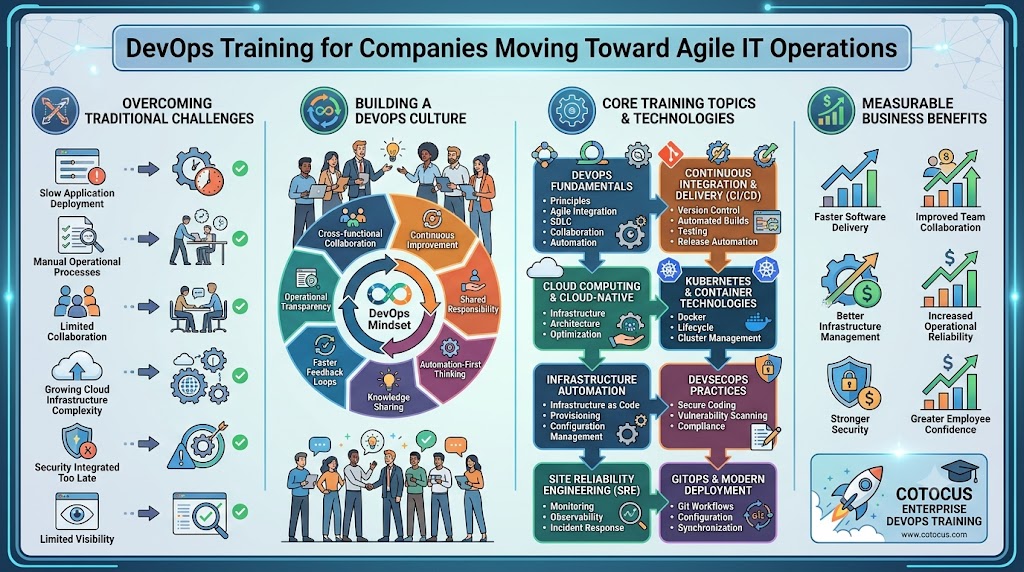
In today’s competitive business environment, organizations are expected to deliver software updates faster, maintain reliable systems, and respond quickly to changing customer demands. Traditional IT practices, where development and operations teams work independently, often create delays, communication gaps, and operational inefficiencies. As businesses embrace agile methodologies and cloud technologies, the need for practical DevOps Training for Companies has become increasingly important.
DevOps training equips IT and engineering teams with the knowledge, tools, and best practices required to improve collaboration, automate software delivery, strengthen security, and build resilient cloud-native infrastructure. Rather than focusing only on technology, enterprise DevOps training encourages a culture of continuous improvement, shared responsibility, and operational excellence.
Cotocus provides enterprise-focused DevOps training programs designed to help organizations build modern engineering capabilities across automation, cloud computing, Kubernetes, DevSecOps, Site Reliability Engineering (SRE), GitOps, CI/CD, platform engineering, and infrastructure automation. Companies looking to strengthen their IT workforce and accelerate digital transformation can learn more by visiting https://www.cotocus.com/.
Why Companies Need DevOps Training
Modern businesses rely heavily on software to support customer engagement, business operations, and innovation. However, many organizations still face challenges that slow software delivery and increase operational complexity.
Some common challenges include:
- Slow application deployment
- Manual operational processes
- Limited collaboration between teams
- Inconsistent development environments
- Growing cloud infrastructure complexity
- Security integrated too late in the development lifecycle
- Difficulty adopting automation
- Limited visibility into production systems
DevOps training helps organizations address these issues by building practical skills and establishing standardized engineering practices.
Supporting the Transition to Agile IT Operations
Agile methodologies enable organizations to deliver value more frequently through shorter development cycles and continuous feedback. DevOps complements Agile by automating software delivery and improving collaboration across technical teams.
Together, Agile and DevOps help organizations:
- Accelerate software releases
- Improve product quality
- Reduce operational bottlenecks
- Strengthen communication
- Increase customer satisfaction
- Support continuous innovation
Enterprise training ensures that teams understand how Agile principles and DevOps practices work together in real-world environments.
Building a DevOps Culture
Technology alone cannot transform software delivery. Successful DevOps adoption requires cultural change that encourages collaboration, shared ownership, and continuous learning.
Corporate training helps teams develop a DevOps mindset by promoting:
- Cross-functional collaboration
- Continuous improvement
- Shared responsibility
- Automation-first thinking
- Knowledge sharing
- Faster feedback loops
- Operational transparency
A strong DevOps culture enables organizations to respond more effectively to business and customer needs.
Core Topics Covered in DevOps Training
Comprehensive DevOps training programs provide practical knowledge across the technologies and practices used in modern software delivery.
DevOps Fundamentals
Participants learn the core concepts behind DevOps, including:
- DevOps principles
- Agile integration
- Software development lifecycle
- Collaboration strategies
- Continuous improvement
- Automation practices
These foundational concepts help teams understand how DevOps supports business objectives.
Continuous Integration and Continuous Delivery (CI/CD)
CI/CD pipelines automate software building, testing, and deployment.
Training typically covers:
- Version control systems
- Automated builds
- Continuous testing
- Deployment pipelines
- Release automation
- Pipeline monitoring
Teams gain practical experience creating efficient software delivery workflows.
Cloud Computing and Cloud-Native Practices
Cloud platforms are essential components of modern IT operations.
Training introduces:
- Cloud fundamentals
- Infrastructure management
- Cloud-native architecture
- Resource optimization
- High availability
- Disaster recovery
- Governance and security
Understanding cloud technologies enables organizations to build scalable and flexible digital platforms.
Kubernetes and Container Technologies
Containerization has become a standard approach for deploying modern applications.
Enterprise training includes:
- Docker basics
- Container lifecycle
- Kubernetes architecture
- Cluster management
- Application deployment
- Networking
- Storage
- Security best practices
Hands-on exercises prepare teams to manage production container environments confidently.
Infrastructure Automation
Manual infrastructure management often slows software delivery and increases operational risks.
Training introduces Infrastructure as Code concepts such as:
- Automated provisioning
- Configuration management
- Version-controlled infrastructure
- Environment consistency
- Deployment automation
Automation improves efficiency while reducing configuration errors.
DevSecOps Practices
Security must be integrated into every phase of software development.
DevSecOps training covers:
- Secure coding principles
- Vulnerability scanning
- Compliance automation
- Container security
- Secrets management
- Secure deployment pipelines
- Policy enforcement
Teams learn how to improve application security without compromising delivery speed.
Site Reliability Engineering (SRE)
Reliable systems require proactive monitoring and operational excellence.
Training includes:
- Monitoring strategies
- Observability
- Incident response
- SLIs and SLOs
- Capacity planning
- Automation
- Performance optimization
SRE practices help organizations maintain stable and highly available services.
GitOps and Modern Deployment Strategies
GitOps simplifies infrastructure and application management through Git-based workflows.
Training includes:
- Git repositories
- Configuration management
- Automated deployments
- Infrastructure synchronization
- Version control
- Operational governance
GitOps improves consistency and simplifies deployment management.
Platform Engineering
Platform engineering creates standardized internal platforms that improve developer productivity.
Training focuses on:
- Internal developer platforms
- Self-service infrastructure
- Standardized deployment environments
- Developer experience
- Platform governance
Organizations benefit from faster development and simplified operational management.
Hands-On Learning for Enterprise Teams
The most effective corporate training programs combine theory with practical implementation.
Hands-on learning includes:
- Building CI/CD pipelines
- Deploying Kubernetes applications
- Automating infrastructure
- Configuring monitoring systems
- Implementing DevSecOps practices
- Managing cloud resources
- Creating Infrastructure as Code templates
Practical experience enables participants to apply new skills directly within enterprise environments.
Benefits of DevOps Training for Companies
Organizations investing in enterprise DevOps training often experience measurable improvements across multiple areas.
Faster Software Delivery
Automation reduces manual processes and accelerates release cycles.
Improved Team Collaboration
Development, operations, testing, and security teams work more effectively together.
Better Infrastructure Management
Infrastructure automation improves consistency and scalability.
Increased Operational Reliability
Monitoring, observability, and SRE practices improve production stability.
Stronger Security
DevSecOps integrates security throughout the software development lifecycle.
Greater Employee Confidence
Practical training enables teams to adopt modern technologies with confidence.
Measuring Training Success
Organizations should evaluate training effectiveness using measurable business outcomes such as:
- Increased deployment frequency
- Reduced deployment failures
- Improved automation adoption
- Faster incident resolution
- Better collaboration
- Reduced operational costs
- Improved production reliability
- Higher engineering productivity
These improvements contribute directly to long-term business success.
Traditional IT Operations vs Agile DevOps Operations
| Traditional IT Operations | Agile DevOps Operations |
|---|---|
| Manual software deployments | Automated CI/CD pipelines |
| Separate development and operations teams | Cross-functional collaboration |
| Long release cycles | Frequent software releases |
| Manual infrastructure management | Infrastructure as Code |
| Reactive issue management | Proactive monitoring and observability |
| Security after development | Integrated DevSecOps |
| Limited automation | Automation-first workflows |
| Slow scaling | Cloud-native scalability |
| Siloed communication | Continuous feedback and collaboration |
Why Organizations Choose Cotocus
Technology transformation requires more than adopting new tools—it requires skilled teams capable of implementing and managing modern engineering practices.
Cotocus delivers enterprise DevOps training programs that combine practical instruction with real-world implementation experience. Training covers DevOps fundamentals, cloud computing, Kubernetes, DevSecOps, Site Reliability Engineering, GitOps, infrastructure automation, CI/CD, and platform engineering, helping organizations develop high-performing IT teams ready for modern software delivery.
By combining consulting expertise with corporate training, Cotocus enables organizations to strengthen internal capabilities while supporting long-term digital transformation initiatives.
Frequently Asked Questions
What is DevOps training for companies?
DevOps training for companies is a structured learning program that helps IT teams develop practical skills in automation, cloud computing, CI/CD, Kubernetes, DevSecOps, and modern software delivery practices.
Who should attend enterprise DevOps training?
Developers, DevOps engineers, system administrators, cloud architects, QA professionals, SRE teams, platform engineers, security teams, engineering managers, and IT leaders all benefit from DevOps training.
How does DevOps support Agile IT operations?
DevOps complements Agile by automating software delivery, improving collaboration, reducing deployment delays, and enabling continuous feedback.
Why is automation important?
Automation reduces manual work, improves consistency, accelerates deployments, and minimizes operational errors.
What technologies are covered?
Training commonly includes Git, Docker, Kubernetes, CI/CD, cloud platforms, Infrastructure as Code, DevSecOps, monitoring, GitOps, and automation tools.
Does DevOps training include cloud technologies?
Yes. Enterprise DevOps training typically includes cloud architecture, cloud-native development, infrastructure automation, governance, and cloud security best practices.
How does DevSecOps improve software delivery?
DevSecOps integrates security into the development lifecycle, allowing vulnerabilities to be identified and addressed earlier without delaying releases.
Why is Kubernetes included in DevOps training?
Kubernetes is widely used for container orchestration and is an essential technology for managing modern cloud-native applications.
How can organizations measure training success?
Success can be measured through faster software releases, improved automation, fewer deployment failures, stronger collaboration, increased productivity, and better operational reliability.
Why choose Cotocus for enterprise DevOps training?
Cotocus combines enterprise consulting expertise with practical, hands-on training that helps organizations build skilled engineering teams capable of supporting modern cloud-native software delivery and long-term digital transformation.
Conclusion
DevOps Training for Companies is an essential investment for organizations moving toward agile IT operations and modern software delivery. By developing expertise in automation, CI/CD, cloud computing, Kubernetes, DevSecOps, Site Reliability Engineering, infrastructure automation, and platform engineering, businesses can improve collaboration, accelerate innovation, and build resilient technology platforms.
Cotocus helps organizations achieve these goals through practical enterprise training programs designed for real-world implementation. Whether your business is beginning its DevOps journey or expanding existing engineering capabilities, https://www.cotocus.com/ offers professional consulting and corporate training services that support sustainable digital transformation and long-term operational success.
