Introduction
Many beginners feel excited about investing in the stock market, especially when they hear about people making profits or building wealth. However, most new investors skip the most important step—learning the basics.
Without proper understanding, the stock market can feel confusing and risky. Many people enter with high expectations but no knowledge of how markets actually work. This often leads to emotional decisions and unnecessary losses.
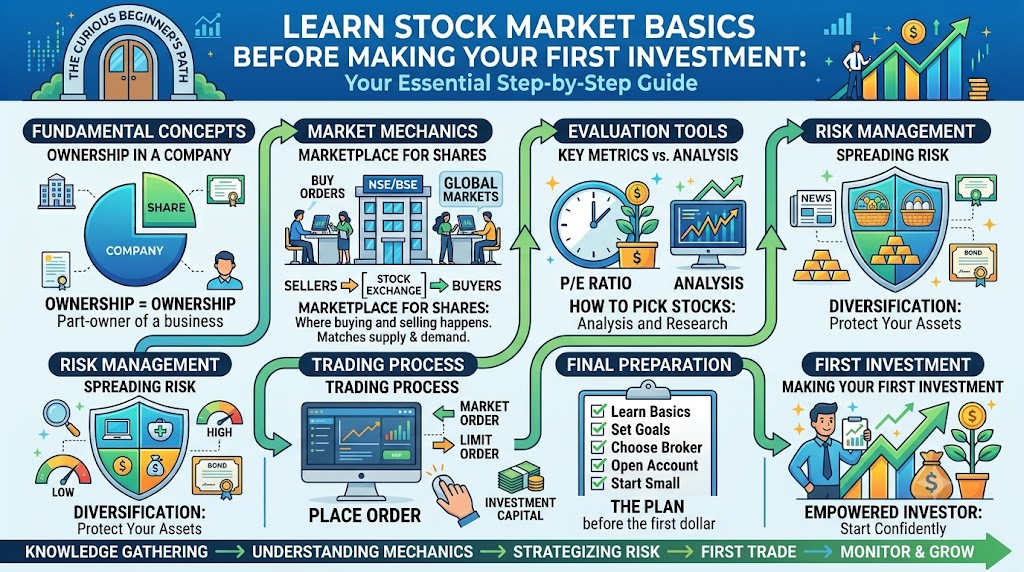
Before making your first investment, it is important to build a strong foundation in stock market basics. Understanding how the market works helps you make informed decisions instead of relying on luck or tips.
This guide from StocksMantra.com explains everything beginners should learn before investing their first rupee in the stock market.
What Are Stock Market Basics?
Stock market basics refer to the fundamental concepts every investor should understand before entering the market.
These include:
- What is a stock and share
- How the stock market works
- What is investing and trading
- How prices move
- What is risk and return
- How companies are evaluated
- How IPOs work
In simple words, stock market basics teach you how money moves in financial markets.
Why You Should Learn Stock Market Basics First
Learning basics before investing helps you:
- Avoid emotional decisions
- Understand market risks
- Identify good companies
- Build long-term financial discipline
- Reduce chances of losses
- Make confident investment choices
Without basic knowledge, investing becomes guesswork instead of strategy.
Stock Market Basics Every Beginner Must Know
1. What is a Stock?
A stock represents ownership in a company. When you buy a stock, you become a partial owner.
2. What is a Share Market?
A marketplace where shares of companies are bought and sold between investors.
3. What is a Stock Exchange?
A platform where trading happens, such as NSE and BSE.
4. What is a Demat Account?
A digital account used to store shares electronically.
5. What is Investing?
Buying stocks to hold them for long-term wealth creation.
6. What is Trading?
Buying and selling stocks frequently to earn short-term profits.
7. What is Risk?
The possibility that the value of your investment may go down.
8. What is Diversification?
Spreading investments across different stocks or sectors to reduce risk.
Investing vs Trading: Simple Comparison
| Feature | Investing | Trading |
|---|---|---|
| Time Frame | Long-term | Short-term |
| Objective | Wealth creation | Quick profit |
| Risk Level | Lower | Higher |
| Analysis Type | Fundamental analysis | Technical analysis |
| Decision Style | Business-focused | Price-focused |
| Stress Level | Low | High |
Beginners should always start with investing before moving into trading.
Step-by-Step Learning Before First Investment
Step 1: Learn Basic Terms
Understand stock, share, market, exchange, and Demat account.
Step 2: Understand How Markets Work
Learn how buyers, sellers, and exchanges interact.
Step 3: Study Companies
Understand what the business does and how it earns money.
Step 4: Learn Risk Basics
Accept that every investment carries risk.
Step 5: Learn Financial Statements
Understand revenue, profit, expenses, and debt.
Step 6: Understand Market Behavior
Learn how news and events affect stock prices.
Step 7: Learn Basic Analysis
Start with fundamental analysis before technical analysis.
Step 8: Practice Virtual Learning
Observe markets before investing real money.
Step 9: Start Small Investment
Begin with small amounts to gain experience.
Fundamental Analysis (Basic Understanding)
Fundamental analysis helps you understand a company’s real value.
It includes:
- Revenue and profit growth
- Debt levels
- Business model strength
- Industry position
- Management quality
It helps identify strong long-term companies.
Technical Analysis (Basic Understanding)
Technical analysis focuses on price movements.
It includes:
- Charts
- Trends
- Support and resistance
- Volume
- Candlestick patterns
It is mainly used for short-term trading decisions.
IPO Basics for Beginners
An IPO (Initial Public Offering) is when a company offers shares to the public for the first time.
Before investing in IPOs, beginners should check:
- Business model
- Financial performance
- Growth potential
- Valuation
- Risk factors
Avoid investing only based on hype or social media trends.
Common Mistakes Beginners Make
- Investing without learning basics
- Following tips blindly
- Emotional buying and selling
- Overtrading
- Ignoring risk management
- Expecting quick profits
- Investing borrowed money
- Panic selling during market falls
Best Practices Before First Investment
- Start learning before investing
- Focus on long-term thinking
- Always research companies
- Diversify investments
- Control emotions
- Start with small capital
- Keep learning continuously
Expert Tips for Beginners
- Knowledge is more important than timing
- Focus on understanding businesses
- Avoid market rumors
- Patience is key in investing
- Risk management matters more than returns
- Consistency leads to better results
How StocksMantra.com Helps Beginners
StocksMantra.com helps new investors understand stock market basics in a simple and practical way.
It provides:
- Beginner-friendly stock market education
- Investing and trading concepts
- IPO learning guides
- Market analysis basics
- Financial awareness content
- Step-by-step learning approach
The goal is to help beginners build confidence before making their first investment.
FAQs
1. What are stock market basics?
They are fundamental concepts like stocks, investing, trading, and risk.
2. Why should I learn before investing?
Because it helps you avoid mistakes and make informed decisions.
3. What is a stock?
A stock represents ownership in a company.
4. What is investing?
It is buying stocks for long-term wealth creation.
5. What is trading?
It is buying and selling stocks for short-term profit.
6. Is stock market risky for beginners?
Yes, but risk can be reduced with proper learning.
7. What is fundamental analysis?
It is studying a company’s financial and business strength.
8. What is technical analysis?
It is studying stock price charts and patterns.
9. Can I invest without learning?
It is possible, but not recommended.
10. What is the first step in investing?
Learning basic stock market concepts before investing real money.
Conclusion
Learning stock market basics before making your first investment is the most important step for any beginner. It helps you understand how markets work, how companies grow, and how investment decisions should be made.
Without proper knowledge, investing becomes risky and emotional. With the right foundation, it becomes structured and strategic.
If you are planning to start your investment journey, take time to learn the basics first and build confidence step by step.
To continue learning, explore beginner-friendly financial education content on StocksMantra.com and develop a strong foundation in investing, trading, IPOs, and market research.
