Introduction
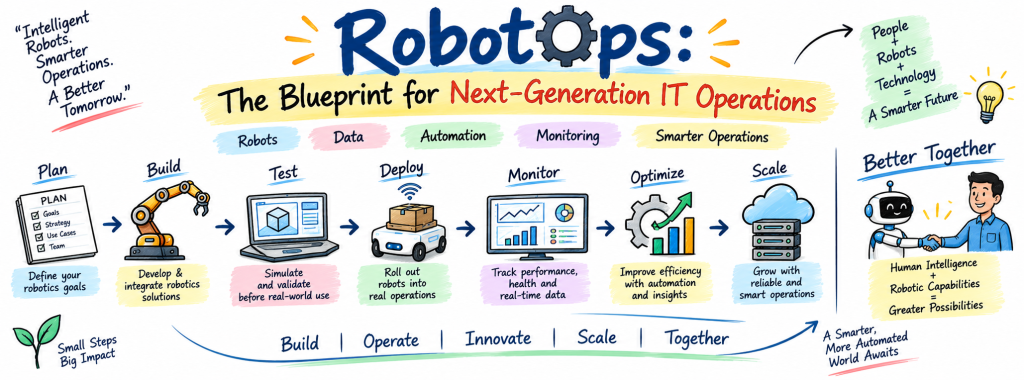
Robots now help people with many types of work. They move goods, build parts, inspect products, and handle repeat tasks.
Yet, a robot needs more than good hardware. Teams need to manage its software, data, updates, errors, and daily tasks.
This need created RobotOps. RobotOps brings robotics and modern software practices together. It helps teams build, test, run, watch, and improve robot systems.
The field covers many useful areas. These include Robotics Operations, Robot Fleet Management, Industrial Robotics, Robotics Software, Robot Simulation, Autonomous Mobile Robots, Robotics Automation, Robotics Operations Center, and ROS 2.
For learners and technical teams, RobotsOps.com offers a focused place to explore these topics. You can visit https://www.robotsops.com/ to learn more about RobotOps and modern robotics operations.
The learning process does not need to feel hard. Start with one topic. Build a small project. Test it, find problems, and improve it.
That simple process can help beginners understand how modern robot systems work.
1. What RobotOps Means in Real Work
RobotOps brings several jobs into one clear process. Developers create software. Robotics engineers work with machines. Operations teams keep those machines running.
These teams need to work together.
Imagine a robot that moves boxes in a warehouse. Sensors collect data around the robot. Software reads that data. The robot then chooses a path and moves toward its goal.
Now imagine that the robot stops.
The team needs to find the reason. Maybe the battery ran low. Maybe the network failed. Maybe the software found an error.
RobotOps gives teams tools and methods to handle such problems.
A beginner can start with these skills:
- Linux basics
- Python basics
- Git
- Software testing
- Robot hardware
- Robot monitoring
- ROS 2
- Robot simulation
- Fleet management
Each skill adds another part to your RobotOps knowledge.
2. Learn the Main Parts of Robotics Operations
Daily robot work needs careful planning. Teams must check machines, review errors, manage updates, and respond to failures.
Robotics Operations covers this work.
For example, a factory may use several robots at the same time. One robot may inspect products. Another may move parts. A third robot may handle assembly.
The team needs a clear view of every machine.
A central system can show robot health, battery levels, software versions, errors, and task status. This view helps engineers spot problems faster.
Beginners can practice these skills with a small project.
Start with one robot. Record its status. Add simple logs. Then create an alert for an error.
Next, add another robot. Compare both systems.
Useful Robotics Operations skills include:
- Health monitoring
- Error tracking
- Log review
- Remote support
- Software updates
- Task tracking
- Safety checks
- Incident handling
This hands-on method can make the topic much easier to understand.
3. Manage Many Machines With Robot Fleet Management
One robot can feel easy to manage. A large group creates a much bigger challenge.
Robot Fleet Management helps teams manage many robots through one system.
A fleet dashboard can show each robot by name. It can also show location, battery, task, network status, and software version.
Consider a warehouse with many mobile robots. One robot may carry a box. Another may wait for charging. A third robot may stop because of an error.
The operations team can see all three states from one place.
You can create a simple fleet project to learn this concept.
First, create two robot records. Give each robot a name and status.
Then add fields for:
- Battery
- Location
- Current task
- Error state
- Software version
- Connection status
- Last activity
After that, add alerts for important problems.
This small project can teach the core ideas behind Robot Fleet Management.
4. Explore the World of Industrial Robotics
Factories use robots for many repeat jobs. Robots can weld parts, move products, inspect items, and support assembly work.
Industrial Robotics focuses on these systems.
A robotic arm gives us a simple example. The arm can repeat the same movement many times. This can help factories keep work steady.
But industrial robots need careful control.
Engineers must understand motors, sensors, controllers, software, safety systems, and factory processes.
Think about an inspection robot. A camera checks a product. Software reads the camera data. The system then decides whether the product meets the required condition.
Every part needs to work together.
Beginners can study common factory uses such as:
- Assembly
- Welding
- Inspection
- Packaging
- Material handling
- Product sorting
Then study the data flow between the robot and other systems.
This approach helps learners understand the full operation instead of looking at the robot alone.
5. Make Robotics Software Easier to Understand
Robotics Software controls many actions inside a robot system. It can manage sensors, movement, cameras, navigation, and tasks.
Modern robots often use many software parts.
One program may process camera data. Another may control movement. A different part may plan a route.
This setup creates a strong need for testing.
A small software change can affect robot behavior. So, teams should test changes before they send them to production robots.
Good software habits include:
- Track code with Git.
- Test changes before release.
- Keep useful logs.
- Track software versions.
- Review important changes.
- Keep a recovery plan.
A recovery plan gives teams a way to return to a working software version.
Software engineers can use these skills when they move into robotics.
Robotics engineers can also learn software practices and improve their development process.
That makes Robotics Software an important part of RobotOps.
6. Test Robot Ideas With Robot Simulation
Testing a real robot can take time. It can also need special equipment and safe space.
Robot Simulation gives engineers a virtual place to test robot software.
A simulator can include a robot, sensors, walls, objects, roads, rooms, or factory areas.
Imagine a virtual warehouse. A robot must move from one location to another. You can add boxes and walls to the virtual area.
Then you can test the robot.
If the robot chooses a poor route, change the software and run the test again.
Beginners can follow this simple process:
- Create a small virtual area.
- Add a robot.
- Add basic sensors.
- Test movement.
- Add obstacles.
- Watch for errors.
- Change the software.
- Test again.
This process helps learners understand robot behavior.
It also gives engineering teams a useful way to test software before they use physical machines.
7. Understand Autonomous Mobile Robots
Some robots need to move through large spaces without constant human control. Autonomous Mobile Robots help with this type of work.
These robots use sensors, maps, software, and navigation systems.
Warehouses can use them to move goods. Hospitals can use them to move supplies. Factories can use them to move parts.
However, teams need to manage more than movement.
They also need to watch battery levels, network connections, software versions, errors, and task progress.
A safe update process can help.
First, create the software change. Then test it in simulation. Next, try the change on one robot.
Watch the robot after the update. Check its tasks and error logs.
If the robot works well, move the update to more robots.
This step-by-step process can reduce the risk of fleet-wide problems.
8. Use Robotics Automation for Repeat Tasks
People often repeat the same work many times. Robotics Automation can help machines handle these tasks.
A good automation plan starts with a clear goal.
Imagine a robot that moves a box from one area to another.
The robot must find the box. It must move toward the box. It must pick up the box. Then it must reach the correct destination.
Each step needs a clear rule.
The system also needs a plan for errors.
What happens if the robot cannot find the box?
What happens if another robot blocks the path?
What happens if the robot loses its connection?
A practical automation process includes:
- Define the goal.
- Break the job into steps.
- Add sensors.
- Create the control logic.
- Test each step.
- Add error alerts.
- Record results.
- Improve the workflow.
This approach helps teams create useful automation instead of adding technology without a clear purpose.
9. Create a Robotics Operations Center
Large robot fleets can create huge amounts of information. Teams need one clear place to view that information.
A Robotics Operations Center can act as that central place.
It can show robot health, battery status, errors, tasks, software versions, and network activity.
Imagine an operator looking at one screen. The screen shows many robots. One robot shows a battery warning. Another shows a network error.
The operator can focus on those robots first.
A useful operations center can track:
- Robot health
- Battery status
- Fleet activity
- Network health
- Software versions
- Task progress
- System errors
- Important alerts
Teams can also use logs to understand what happened before an error.
Remote teams can check this information before they visit a physical robot.
As a fleet grows, a Robotics Operations Center can become an important part of daily RobotOps work.
10. Build ROS 2 Skills One Step at a Time
ROS 2 helps different software parts communicate inside robot systems.
The platform can look complex to beginners. So, start with small ideas.
A node handles a specific software job.
A topic lets software parts share ongoing data.
A service handles a short request and response.
An action handles a longer task and can show progress.
You do not need to learn everything on your first day.
Try this learning path:
- Create one node.
- Publish simple data.
- Read a topic.
- Try a service.
- Try an action.
- Read logs.
- Test your application.
For example, one node can read sensor data. Another node can use that data to control robot movement.
This simple example shows how different software parts can work together.
ROS 2 can give learners a strong base for Robotics Software and RobotOps.
11. Follow a Simple RobotOps Project Path
Many learners struggle because they try to study too many tools at once.
A project-based path can make learning easier.
Use this cycle:
Learn → Build → Test → Run → Monitor → Improve
Start with one small idea.
For example, build a robot health dashboard. Show the robot name, battery, task, and status.
Next, add error messages.
Then add alerts.
After that, add two more robots.
You can also try projects such as:
- Robot fleet tracker
- ROS 2 application
- Robot simulator
- Health monitoring tool
- Error alert system
- Software version tracker
- Operations dashboard
Each project should solve a simple problem.
Ask yourself:
What does the robot do?
What data does it create?
What can go wrong?
How can I find the problem?
How can I fix it?
These questions can turn basic study into practical experience.
12. Write Better RobotOps Content With Modern Search Methods
Good technical content should help people first.
That goal also supports AEO, GEO, LLMO, and AISEO.
AEO, or Answer Engine Optimization, helps content answer direct questions.
GEO, or Generative Engine Optimization, helps content work well with generative search systems.
LLMO, or Large Language Model Optimization, focuses on clear information that language models can understand.
AISEO, or AI Search Optimization, focuses on content for search systems that use AI.
You can support these methods with simple writing.
Give direct answers. Explain difficult words. Add real examples. Use clear headings. Break complex tasks into steps.
Also, follow E-E-A-T.
Show real experience. Explain your knowledge. Use trustworthy facts. Give readers useful examples.
Strong RobotOps content can include:
- Step-by-step tutorials
- Real use cases
- Case studies
- Success stories
- Practical examples
- Detailed comparisons
- Original insights
- Expert interviews
- Research data
- Unique frameworks
This approach helps readers understand technical topics without feeling lost.
Practical Skills That RobotOps Learners Can Build
Learning becomes stronger when people create something useful.
A small project can connect many RobotOps ideas.
For example, you can build a robot monitoring system. Start with one robot. Track its health and battery.
Then add logs. After that, add alerts.
Next, add a second robot and create a simple fleet view.
You can also create a Robot Simulation project. Test movement and add obstacles.
Another project can use ROS 2. Create two nodes and let them share data.
You can also study real business use cases.
Look at warehouse robots. Study factory robots. Explore inspection machines. Review autonomous delivery systems.
For every example, ask five questions:
- What problem does the robot solve?
- What data does it collect?
- What can make it fail?
- How can teams detect failure?
- How can teams recover?
These questions help turn theory into practical thinking.
Frequently Asked Questions About RobotsOps.com
1. What is RobotOps in simple words?
RobotOps means managing the software and daily operations that keep robots working well.
2. Who can learn RobotOps?
Students, software engineers, robotics engineers, DevOps engineers, automation professionals, and other technology learners can study RobotOps.
3. What does Robot Fleet Management mean?
Robot Fleet Management helps teams manage many robots through shared tools and dashboards.
4. Why should teams use Robot Simulation?
Robot Simulation lets teams test robot software in a virtual environment before they use real machines.
5. What does Industrial Robotics cover?
Industrial Robotics covers robots that support factory work such as assembly, inspection, welding, packaging, and material movement.
6. How do Autonomous Mobile Robots work?
Autonomous Mobile Robots use sensors, maps, software, and navigation systems to move through their surroundings.
7. Why do robotics teams use ROS 2?
ROS 2 helps different software parts communicate. Developers can use nodes, topics, services, and actions.
8. What does a Robotics Operations Center provide?
It gives teams one place to view robot health, errors, tasks, software versions, and fleet activity.
9. Which skills should beginners learn for RobotOps?
Beginners can start with Linux, Python, Git, testing, and basic robotics. They can then learn ROS 2, simulation, monitoring, and fleet management.
10. What can learners explore on RobotsOps.com?
RobotsOps.com covers RobotOps, Robotics Operations, Robot Fleet Management, Industrial Robotics, Robotics Software, Robot Simulation, Autonomous Mobile Robots, Robotics Automation, Robotics Operations Center, and ROS 2.
Final Thoughts
Modern robot systems need people who understand both machines and software.
RobotOps brings these areas together. It gives teams a practical way to develop, test, deploy, monitor, and improve robots.
You do not need to learn every topic at once.
Start with Linux or Python. Then learn basic robotics. Move into ROS 2 and simulation. After that, explore monitoring and fleet management.
Build small projects along the way.
Create a dashboard. Test a virtual robot. Track robot health. Add an alert. Try a software update.
Then explore Industrial Robotics, Autonomous Mobile Robots, Robotics Automation, and Robotics Operations Centers.
Keep your work connected to real problems. Learn from failures. Record what you discover. Share clear examples and useful lessons.
This approach can build strong RobotOps knowledge over time.
Most importantly, remember one simple rule:
Learn one thing, build one thing, test one thing, and improve one thing at a time.
